

This episode was recorded on July 10, 2025.
About This Episode
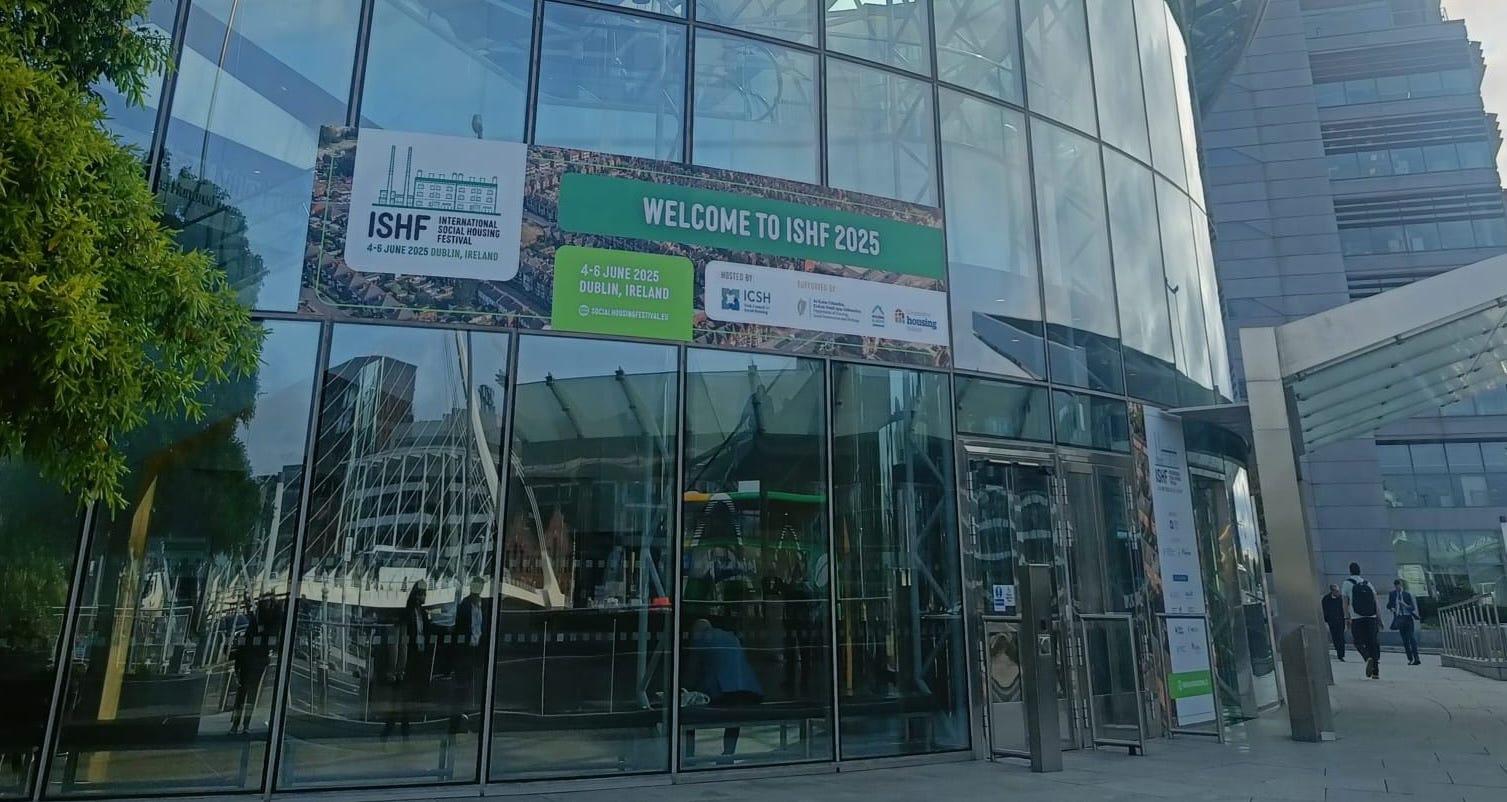
Of course all of our episodes are special, but this one is extra meaningful because our amazing editor and producer Tina Lee is stepping out from behind the mic for the first time, joining us in a new role as special correspondent. Tina was an attendee earlier this summer at the big social housing festival in Dublin, Ireland, hobnobbing with an international array of interesting people with generally interesting ideas about housing, including a few Housing After Dark alumni.
Today, we are digging into what she saw and heard at the festival, including the differences between Americans and everyone else when it comes to social housing talk. If you're new to the social housing world, check out some of our archives on this site, including recordings done at the Institute for Metropolitan Studies at San Jose State University, where I'm a visiting scholar. If you're a long time social housing nerd, or have recently been to Vienna or Singapore or France or Denmark, or so many other places that do housing better than we do, and you're ready to do things differently. I hope this episode helps nudge the process along.
Social Housing, for me, is two things, full stop. It is shorthand for a better housing system. It’s ideal for folks who know only a systemic approach will work and are committed to actually doing change across the full housing system, and it's a call to Americans to recognize that other countries do housing better and that we can learn from elsewhere, especially if we're willing to adapt things to our crazy, sprawling, hyper diverse and historically messed up land where we have no choice but to adapt to the facts on the ground.
Thanks, as always, to our listeners and subscribers. This podcast also marks the beginning of the end of Tina's tenure as editor, and I just want to thank her, from the bottom of my heart, for making this podcast possible. There would be no Housing After Dark without her. As Tina moves on, it's also transition time here at the podcast. In order to continue, Schafran Strategies needs a partner. If you or your org or company can see a future in which you have a great housing podcast as part of your offering to the housing world, hit me up, and let's see if we can't do something valuable and amazing for the housing community together.
This Episode’s Guest

Tina Lee is a recent graduate from the Master in Public Affairs program at the Princeton University School of Public and International Affairs and has been working part-time at Schafran Strategies throughout. During graduate school, she has worked as a Graduate Researcher at Eviction Lab at Princeton University and a Housing Fellow in the Deputy Mayor’s Office for Housing, Economic Development and Workforce in New York City. Previously, she worked on the Housing and Community Development Team at the National League of Cities managing eviction prevention technical assistance programs for cities in partnership with the Stanford Law School Legal Design Lab and research projects on topics such as short-term rentals and the impacts of institutional investors in local housing markets.
Interview Transcript
Alex Schafran: Tina Lee, welcome to Housing After Dark, even though I guess you've been here all along, just nobody's ever heard you.
Tina Lee: Thanks for having me. It's good to be here even if it’s a bit strange to be on this side.
Alex Schafran: So as I said about intro, this is a very special episode of Housing After Dark where our very own Tina Lee, the editor and producer of this fine podcast from day one and my partner in crime in many things related to housing, steps out from behind the editing desk to act as our special correspondent, our Stephen Colbert to my Jon Stewart, even if I want to be Trevor Noah, to give us a report about her recent trip to Dublin for the Social Housing Conference.
Tina Lee: Festival, actually, social housing festival.
Alex Schafran: Did it feel like a festival?
Tina Lee: It was pretty celebratory. Yeah. And the funny thing is, a lot of my American colleagues who've gone refused to call it a festival.
Alex Schafran: Well, we're gonna come back to this kind of cultural questions of Americans in Europe, in social housing and in general, how the global housers treated our fellow compatriots and our housing system and our presence, especially in this current moment. But we wanted to start with your eagle eye for what you heard from the non-Americans that were there. What are some of the biggest highlights? I know that excitingly, a lot of it was about housing finance.
Tina Lee: Yes, there was a big focus on housing finance. And I reached this conclusion both because there were a lot of sessions that were focused on the topic, and also, as someone who was in a lot of these rooms, both on housing finance and not, the attendance was high in particular in sessions on financing.
One of the things I found most compelling was this focus on cost rental housing. Cost rental housing is a new housing tenure in Ireland established under the Affordable Housing Act of 2021. Given that the festival was held in Dublin, I am assuming that's why there was so much of a focus on cost rental. The aim of cost rental housing is to provide long term, secure rental options to households who are above the income threshold for social housing eligibility and whose net income is under a certain threshold.
But what is cost rental? As the name suggests, it's housing where the cost of rent is set at the cost of building and maintaining the housing. So rent is set at a sufficient level to cover the cost of design, site acquisition, building and long term maintenance. I think the number of years to run that price calculation of maintenance is about 40 years, if I'm not mistaken.
There are approved housing bodies who are independent nonprofit organizations that essentially have the authority to build the homes, buy existing homes and lease private homes. But essentially, the overarching goal which the approved housing bodies are the vehicle for is to provide more non-market rental housing to a wider cohort of households.
And I think what the cost rental housing tenure does really well, which we don't do well in the US, is kind of creating this support, this government support, across a broader spectrum of housing. I think they even articulate it as much in their plans or policy reports around cost rental. It's really focused on this segment of middle income folks, or folks who otherwise don't qualify for social housing or social support in the form of rental assistance, but who would otherwise have difficulty affording in market rate housing. And the other thing to note is similar to the Vienna models, that once you qualify for cost rental housing, you don't get kicked out once your income goes above whatever that income threshold is.
I think there's two pieces to pull out there of how the cost rental model could be an inspiration to the US. First, the US has created this very two tiered system and how we do housing support. You know, early in the New Deal, there were programs that were suggested that supported this kind of bigger, more robust vision of supporting across the housing spectrum, in particular this kind of middle segment. But in the 1937 Housing Act, this kind of form of middle income housing support was largely omitted, and instead of what we were left with was a federal government that chose to support either on the low end of things, public rental housing for low income Americans, and then really subsidizing private homeownership with not much in between. And as we've seen, that hasn't played out very well for housing outcomes.
Secondly, they actually focus the question of the cost of the rental at the cost of construction and maintenance, which I think is a smarter, easier, kind of bureaucratically simpler way of approaching the pricing question. Instead of having what we have, which is this really complicated system of setting rents to AMI and redoing that calculation. The fact that Ireland was actually able to set the cost of rent at construction and maintenance, and still have affordable rents is really telling, right? That's very hard to do in America, in part because it is so expensive to build.
Alex Schafran: I think it’s, at the very least, independent of the specific model, for new construction, the more that we can root the question of how much it costs, the better. Like this is just how much it costs to make buildings. And there's some variations, and I think we can obviously get some efficiencies, and we can make certain things cheaper, but at certain point in time, if you're going to pay people a decent wage to build the buildings, and you're going to build them to a certain basic safety standard, and livability standard, it's just going to cost a lot of money. And the fact that they're able to read the conversation and say this is how much it costs to build a building, and we're going to try to take some of the profit out of it, or a huge amount of profit, doesn't mean people aren't getting paid, but I agree, we have at times, a well meaning system in the United States that tries to identify how much money people have, and then somehow deliver a bunch of housing that fits people based on how much money they have, and unfortunately, housing doesn't work that way. Well, that's really exciting, and I'm excited in general, to hear that housing finance is such a central part. We'll talk more about that when we get into the questions of definition, which were a key part of what you heard. For me the simple answer, one of the simple ways of defining social housing is just a better conversation about housing finance.
There was also an exciting model that you heard coming out of the Dutch,a social housing guarantee fund. Will you explain that a little bit?
Tina Lee: Yes. So in the Netherlands, there are social housing associations who own nearly 30% of the housing stock in the Netherlands, all of which operate without direct subsidy from the government. There are other elements of the financing system which someone with far more knowledge about the Dutch system can share more about, but the one element that the session focused on was the guarantee fund. So essentially, the guarantee fund for social housing is a triple layer guarantee that is ultimately carried by the government, which would essentially issue industry loans to social housing providers. The guarantee fund acts as a lender of last resort. It has actually never been used and has a triple A credit rating and with the funds guarantee, housing associations effectively have an open line of credit that is based on the value of their portfolio, which makes accessing debt really easy and really reliable. And in this case, the government isn't necessarily spending any money, but they're acting as a guarantor to help enable these social housing associations to have access to much more favorable loan rates, which gives them essentially access to steady and low interest capital to finance new projects.
Alex Schafran: It's another one of those pillars, right? If one pillar is really rooting the housing conversation around the cost of what it actually takes to build peace and quality housing, the other is like, if you think about how to finance it, this basic understanding of the certain institutions, whether the government or I think in the US case, at times it will also be philanthropy, things like the partnership an expanded version or of the partnership of the base future type of model where a small number of actors agree to put themselves in the first loss position and guarantee it, and in a way that encourages a lot of private capital to go in, but to do so under certain terms. I think that you've seen that there is plenty of capital out there that if their money is guaranteed in a certain way, they will take a lower return in order for that certainty. It's the history of so much good housing is like that exact process. I mean, you argue the entire US Post War mortgage system is some variation on FHA mortgage insurance, essentially the government promising that if something goes south, we got your back and you won't lose money. You'll do it for a social rate. Not surprised that this is coming out of the Dutch, we always hear of them doing smart things, and we all know from Zach Taylor being here that they're particularly good at risk management, because everything is constantly at risk of flooding all the time. I'm sure if we had more time, we can get more into the area and ways in which the Dutch social housing space is interacting with their climate adaptation work. Maybe that's even a future episode where as a correspondent, maybe we can even bring Zach Taylor back.
But I would love to do now in terms of surprising candidates for Tina Lee, top three most interesting things that she heard are from the Aussies. Now, I know that there's a good comparison for us, because it's super suburban, and they have a really dark history of racism and colonialism, just like us. So I do like that, and they also have a deep appreciation for many different codes of football, which means we have a lot in common. But what aspect of the Aussie system did you hear at this Social Housing Conference in Dublin that you liked?
Tina Lee: Yeah. I mean, liked is maybe a strong word, but I mean exactly as you're suggesting. I think it's hard in America, to talk to people who either work in housing or who are just people who care about housing but maybe don't work in it, to come to them and be like “Oh, Vienna is doing this, or the Netherlands is doing that.” The system is just not the same. The fact, as you mentioned, that Australia is a really good comparison to the US, because the housing market, preferences and housing that people, the emphasis on homeownership, etc. is all similar, it is a better competitor than maybe our Western European counterparts.
They had a session talking about community housing, which is essentially, affordable rental housing managed by nonprofit organizations, which is distinct from their public housing system, which is managed by the government. But anyway, the whole point is that they had shared both the model and the fact that it was effective at keeping people stably housed. But in the session, they said it's not a long term sustainable model to Australia's housing crisis.
And I went up to the woman afterwards, and I asked her, “Why would you say it's not a long term sustainable model?” And again, it came back to a question of funding. She was like, we've not adequately funded this system. All of these community housing organizations are just scraping by, they’re some of the most innovative people I've ever met in terms of cobbling together funds to make sure that the program still run but in at the end of the day, it's not long term sustainable, because we're not giving it the amount of money that we need. And you know, the government consistently gives these little short term injections, these little sugar hits, but it's not building the sustainability and the capacity of the sector. So it's not that you didn't believe in the model, it's just that it wasn't financed well enough. And I think that's kind of a really telling tale, and sometimes it is useful to hold up a mirror. In this case, it's Australia to the US about one of our big challenges is that we just don't fund whatever the program is, whatever the type of housing is. We don't fund it adequately, and then it becomes this kind of negative feedback loop of, “Oh, it doesn't work.” But actually, the reason it doesn't work is because we haven't funded it, but then people don't want to fund it because it doesn't work, and we just end up in this kind of shit storm that we're currently in. So I thought that was a useful example in so far that it’s a really useful mirror to hold up to the challenges we face in the US.
Alex Schafran: Yeah, I love them as an example and a place to learn from. For me, it's there's one of the other key themes of social housing that I think I've talked about in other pieces is, you know, social housing is fundamentally about Americans for the first time, really true or not, the first time Catherine Bauer learned a ton in the early days we there was a lot of time in the 20s, 30s, where we were studying European housing systems and trying to learn and adopt we kind of stopped once we thought that we had reinvented housing for everybody in suburbia. But I feel like it's this time where we're really learning. And I agree people really as much as people go to Vienna, or they can go to Singapore, where it's much more homeownership oriented, and I think it provides some really good models for how to do multi-family home ownership in a social housing kind of setting. Yeah, everything about Singapore is so different from us. They also do have a oftentimes very right wing government that at least helps us understand.
But yeah, I love that you're bringing the Aussies, especially because I think it's super helpful when we have examples where there's things that we can learn, or we can see other people that have the same failures. And I think the Canadians are in the same kind of boat. There's like the three of us are the sort of, you know, bastard children of the Commonwealth, with our huge territories and resource dependent and histories of racism and colonialism and and genocide of native peoples and like these big suburban places where you've got to make something that works in a single family home zone. And we all have a tendency to have these little sugar hits, of these injections of capital, but it's not a long, sustained term thing.
And I think that's another way I think of thinking about, like, you gave me some I think there's a good nutrition metaphor there for social housing. We've all survived on very bad diets in the housing space, a lot of sugar, a lot of empty calories, a lot of wasted energy, and it's just like time to get our protein and carbohydrates and lean fats like in order, especially when it comes to an aging housing stock. As somebody with a rapidly aging body, I've learned that the diet really matters, and I think our housing system is the same.
Okay, so enough nice things about the Aussies. One thing I was excited that you noticed in our first conversation about this is that even if finance is the main thing, we maybe should keep the main thing, the main thing. This was about more than just finance, and actually more than just housing. So will you explain what you saw that made you say that?
Tina Lee: Yeah, it was a few things that I’ll rattle off in no particular order. I think one of the really telling things is, you know, obviously, this conference has only been going on since 2017. It only happens once every two years, so there's not been that many of them. Obviously the US presence is relatively small, but in all of the representation from other countries, it was really this kind of, not just whole of government, but whole of government and whole of industry approach as well.
For instance, in a lot of the sessions, folks there were part of the construction industry. There was a big focus on construction innovation. There were doing timber housing, universal design, off site construction, all of that. And it's a really integrated piece of the conversation with the policy side of things, with the government side of things in a way that places like California are starting to do, but maybe aren't as integrated as they seem to be in other countries. And there was this really big focus on sustainability in both this like political interlinking between housing and climate that I think, again, we're, we're starting to do politically and as policymakers in the US, California is maybe a bit of ahead of the rest of the country, we just aren't on the same level, and in creating this political linkage, also compelling industry to care as well.
I think a lot of the reason why that we saw industry care is, it's a response to a regulatory environment that has created an enabling environment, a stable environment, for the construction industry to realize that, like, “Oh, we need to be innovating as well to meet kind of policy targets or regulatory targets” or whatever else it might be. So seeing both this really strong link, and then this feedback loop that was so strong in other countries that I think hopefully we'll get to that place in the US, but aren't quite there yet.
And then last thing I'll mention, which is still related to housing, but maybe a slightly different side of the financing piece of it, which we focus on was this focus on tenants. You've talked about it on this podcast a lot, and then on the Substack as well, but this difficulty in the tenant equity side and the YIMBY side of the conversation, and this kind of like political tension that just did not exist in the same way to me.
A lot of the conversations that we were having at the social housing festival was about the tenant side of things, both how tenants organize in social housing, how we serve them as a constituent, the recognition of them as a really important part of the conversation, and not seeing it as this kind of either or, but, but of both and in terms of the tenants and also the supply side.
Alex Schafran: In many ways, the festival, it's a perfect metaphor for social housing. I mean social housing for me as the conversation, it's really just sort of like all of the good ideas that we have in housing, full stop. And yeah, a conference is not big enough to incorporate all the good ideas you need to have a festival. it's interesting. I know we've been hearing from various conversations that are happening in California about social housing that people are really getting tripped up on, like, very small things, including things like resident participation or resident voice. Well, oftentimes, I think in other countries, it's just treated as a technical issue that you, of course, incorporate people's voice, and you give them options and choices on how much they want to participate, and you give them a full range. If they want to have equity, they can have equity. And if they don't have equity, they don't have to have equity. And if they want to go to a lot of meetings, they can go to a lot of meetings. And if they don't want to go to a lot of meetings, they don't have to go to a lot of meetings.
But rather than making it a subject of division and controversy, it's just sort of, like, another technical thing that fits with and generally in kind of a general ethos that embraces, like giving people real choice, giving people real voice in their housing. It's also great to hear about all the construction folks that are there. And you know, there are so many, like, small, innovative and large, innovative for profit corporations that build things that need to be part of this. I think that's been one of the big successes that you have in all these other countries. And so really happy to hear that they were at the show as well. I'm kind of jealous now more and more that I wasn't there.
Let's go back. So there was one more thing that you found by listening to the non-Americans that you found interesting to have a difference, and that was, like a few slight but significant differences in the narrative of how people talk about social housing, what was, what was so interesting?
Tina Lee: I think maybe two elements to that one. First of all, obviously this is a collection of people who come to a festival conference on social housing, so they've already bought into the idea. But there was really this, whether it was the Minister of Housing of Ireland or or these people who are high up both in government and industry, this recognition that it's like a moral imperative to address our housing crisis, and social housing being one of the big ways that we can do that.
And also this emphasis on industry partnership. I think, in the States, in a lot of political spaces, and I think it's for the right reasons if we look at history and how the private sector is treated or operated in the housing space, but this emphasis on industry partnership, and that there's not this antagonistic government versus the private sector, or tenants versus landlords.
There was this idea of the government being at the helm of the ship, it reminded me of Mazzucato-esque arguments about the Mission Economy and government being at the helm of helping steer the private sector, which is ultimately a part of our housing industry, towards more socially optimal outcomes that maybe the private sector wouldn't have reached on its own. I don't think those Mazzucato-esque arguments have necessarily reached the US in a really substantive way, but that's kind of how I see some of the solutions to our housing crisis in the US.
We do need the private sector, but the government needs to be at the helm. How can we make this happen in the US? And, you know, I think going to the festival and seeing a lot of countries kind of adopt this mentality, have this approach, I think is, you know, a useful kind of North Star, I suppose, when we think about our aspirations as a country.
Alex Schafran: I couldn't agree more again. So I think by this point, we've already defined social housing in a bunch of different ways. One of my new favorites is that social housing is this perfectly, beautifully operating public private nonprofit partnership, right? This thing where everybody in all the different corners and sectors, not just what it says in your incorporation papers, but are you municipal corporation or a nonprofit corporation or for profit corporation, but also your size and the type of things that you do like operating as a system that, as you said, is socially optimized.
You know, it's also probably environmentally and economically like your old school 3E optimization, but it's this collaboration. We have this tendency in the United States to make it seem like for profit corporations will somehow not be central to it, whereas they're absolutely central to all of the systems. I mean, it's for profit architecture and development firms that are often building housing. I love to send people the list of the annual Singapore Housing Development Board awards every year that they give out to the best general contractor and best architecture firm. And these are all like big for profit entities that are doing quite well and are quite happy with the arrangement. And we make it seem like a competition.
The one thing I would maybe say, and this is something we can discuss coming up, is, a public sector led system in the United States will be a hard sell. I think big business and business in particular are still too focused on how important they are to this that so many people, ideologically, are not capable of allowing the government to lead, even though they're seemingly turning a blind eye right now to certain people just doing it, whatever the hell that they want in government. So maybe this is changing. Maybe we're now, we're prepared for the government to just do things, but I think some sort of power sharing agreement where everybody's kind of leading everybody to this social optimized level, and it's more about figuring out what everybody does best and letting them do their job, and letting the other people do that job and not having these ideological fights. I'm glad that you brought mazzucato in. I'm glad you're bringing some real intellectual firepower to this podcast. It's about time that we started talking about big ideas and famous Italians.
So with that in mind, we've talked a little bit about some of your key highlights from the overseas crowd, but the secret reason that really made you a true correspondent is we, kind of you went there, paying a little bit closer attention to our fellow American housers who may or may not be listening to this podcast as we speak to apply your sort of critical editorial eye to what they were saying, and how they were saying and how they're talking about social housing. So what did you hear from Team housing in the USA? There was a session, right? There was a sort of formal session, who talked about what?
Tina Lee: Yes, it was a great session with representation from the big players when we think about the US social housing conversation. The Terner Center was there, the Center for Public Enterprise was there, which among other things, provides technical assistance to cities who are interested in setting up similar revolving loan funds as the famous Montgomery County example. I believe representation from Portland and Los Angeles were there as well. It was really interesting to hear Team US try to share a room full of non-Americans or people from other countries with really robust and sophisticated social housing sectors, what social housing is. And it was clear, based on their presentation, both how nascent it was and also how much of the conversation revolved not just around the mechanics of how they get things done, but also the kind of politics of getting that done.
It felt like a social housing 101 presentation from a place that hasn’t quite figured out what that looks like yet. And it was really funny at the end they're taking questions from the audience. And there was a man from the Netherlands who was there who raised his hand in a classic Dutch fashion asked a very dry, blunt question. And he's like “You share this example of Montgomery County, but it was only 100 or 200 units, and not all of them were affordable. This seems like a great model. It seems promising. You all are kind of lauding this as a model to watch and emulate. Why don't you just build more? Why don't you just find finance more?”
I'm one of the many Americans around the room and we're kind of all just looking around and just thinking like: Yeah, why? Why don't we just do that? I think sometimes it's getting people from the outside to ask these kind of really silly and simple and absurd questions that we would never kind of ask ourselves. But it was this really poignant moment of reflection of the kind of absurdity of where we are in America and the challenges that we face, and how something that seems so simple to this man from the Netherlands and the audience could be so complicated for us to actually implement.
Alex Schafran: Well, shout out to all the Americans who went and especially folks I think Helmi Hisserich, was there one of my favorite social houses in this country. We all love Montgomery County. I'm glad that Paul Williams's team was there. It takes a lot of courage. I think, just being American in that environment where it's a little bit like the Men's World Cup in football, and soccer, which is like the rest of the world is just much better. And we're not used to being in last place.
It's great that people are willing to kind of go there and put themselves and put themselves in, again, in a position where they're not going to be the best in the room. And the things that people like the are going to ask these very I can even picture, you know, the Dutch man asking, in a very dry way, the very obvious question of, why don't you do things just completely different and do it more like, what's stopping you? Aren't you the richest country in the world?
It sounds like you weren't alone, that there were quite a few Americans that were there. But one of the most exciting things, and this is one thing that we, we both talked about beforehand, that to pay attention to is that there were folks from public housing authorities in Dublin and now, sadly, and I mentioned this in various sub stacks like public housing and PHAs have often been left out of both the sort of equity version of the future of social housing and the yimby version of the future of social housing. What did you hear? And who did you hear about it?
If you were a PHA and you were in Dublin, that's amazing. I hope you just appreciate that your presence in Dublin is progress.
Tina Lee: Yeah, there was a lot of representation from the PHA world, from really small housing authorities to larger housing authorities, which I think was really interesting or really exciting, in so far that they were interested in getting into the business of social housing, or at the very least understanding what it is. There are so many PHAs in this country, all of which probably have very different ideas of what the future of PHAs should look like. Not all PHAs are going to want to get into the social housing business or see themselves as part of this basic conversation, but I think it's really telling or a really good step in the right direction, as you mentioned, that there are folks who lead housing authorities who are now part of the board helping direct some of the conversations around SB555, the California study around what social housing could look like.
No one knows yet what the answer is to this seemingly central question that we keep dancing around, which is, what role should housing authorities play in the social housing conversation, or in implementation of social housing in the United States. While we don't know what the answer is, the fact that we're asking it and they're asking it is a really good step in the right direction, because ultimately, this is how we've done the business of public housing in the US for a really long time. This infrastructure exists, this apparatus exists, this really good source of knowledge about implementation, and pragmatically, it's also just like an infrastructure and service that has existed for a long time, right? We can't be doing it over. I think most, if not every person you ask, “If you could create the system, the housing system from scratch, would it be the system that we have now?” The answer would be no, right? But we kind of have to start from somewhere, and it would be kind of stupid not to involve PHAs in this conversation as we figure out what social housing in the United States could look like.
Alex Schafran: Amen, absolutely. And I think again, to the credit of folks, folks like Helmi and Jennifer LeSar and others that have really helped, at least in California, drive this conversation, have taken a lot of people to Vienna, is that the number of people that are coming from public agencies, from public public sector, who have been attending, who are really looking for answers. I think they're a really, really central part of this. So, you know, housing authorities have been a little bit on their own for a very long time, and they've been encouraged to be innovative and entrepreneurial, oftentimes in really bad ways, or oftentimes because of, like, very kind of neoliberal stripping of resources. Sadly, we're going to be in one of those moments soon. But I think part of the answer is, they are going to need to do a lot of different things. And I'm excited.
I think there's some really creative folks at the head of housing authorities all throughout California, and I'm assuming also in the other parts of the United States, that I think are hopefully prepared to take the next steps. And as you said, great work by the folks at HCD and a Terner on SB 555, for making an effort to include more folks in the PHA world in that conversation and in all the other conversations that are going on. I think that they are central, just like educator houses and teacher houses again, anytime the public sector is somehow involved in making housing that's social housing. That's another definition for you. I don't know how many definitions we're at this point today, but we'll write them down for you all later. Okay, speaking of definitions, we've been kind of winding our way to this question because you noticed something that has been driving me insane and for a long time, which is this struggle that the Americans in particular have.
First of all, it's like a tendency that Americans have to always have to start every conversation with a definition. And I was asked recently, and by somebody doing research on social housing, and they gave me a definition, and they want me to react to the definition. And I think they were not particularly happy when I told them that that's the wrong question, like, stop starting with the definition, but so does everybody. Did the Americans really kind of start the question with the definition, and I think you and I might not see the definition question quite in the same way.
Tina Lee: Focus maybe isn't the right word, but this question was circulating a lot, both in the formal and informal conversation, of “What is social housing?” It feels like a lot of people that I talk to, they're like, “Yeah, we're really stuck in this phase of, like, defining what it is.” Portland, for instance, is undergoing this study right now, directed by a city council resolution, to explore what social housing could look like in the City of Portland. And part of answering that question is defining what it is and proposing some ideas for the city council. So I know you have some frustrations with how much we're focusing on asking the definitional question.
But I feel like, as someone who you know was in formal training in public policy or public administration, whatever you want to call it, I think that the definition is quite important, right? When it comes to writing law, we need to be precise about what we're legislating. And I think it's really hard to strike this balance, especially we're in such a like nascent phase of what social housing is to both trying to build a political movement around something that is kind of amorphous, and also trying to write law or legislation around, trying to build some momentum around this, which requires some firm definitional components as well.
I don't know necessarily what the answer is, both to the question of how we should define social housing (well, I feel like I have thoughts on how we should define social housing), but I don't know how much or we shouldn't be debating this question of social housing.
Alex Schafran: So if we agree to slightly disagree on like, how much maybe we have slight difference in how much defining needs to be done, you said you do have some thoughts about what some of the definitions could or should be. So, yeah, what is it for you? What is social housing for you?
Tina Lee: In a really broad sense, it's just that the government plays a role in supporting building, financing, housing. And obviously there are a lot of specific models that could exist within that. But I think when you use such a broad definition, we can already see that we are doing some of that in America. Like there are CLTs, there are co-ops, all this fits under the umbrella of social housing. And I think you know, as the theme of this whole podcast has been that there are a lot of potential definitions of what it could be. And maybe that's the point, right? Maybe it is just the point that it is a really broad kind of umbrella and repackaging of a lot of the ways that we piecemeal kind of support the housing system, but that we just need to be doing a lot more of it.
Alex Schafran: In your imagination of social housing, does something like my single family home in which I own, which we have a mortgage income tax deduction. That's a direct subsidy from the federal government, from our taxes every year that covers a certain percent. It's not, means tested, but it is capped, so it's only up to a certain value of the house. Does that make my house part of the social housing system? Do you think, or should we? Should we be seeing things like the mortgage income tax session as which people have long pointed out is the largest housing subsidy in America? Rather than defining that out, should we define that into the social housing system? Maybe we could change the rules. We can make it means tested, so that it's capped at 200% of area median income, or something like that. We could change how it's done. But does it fit the “government money touches it” criteria?
Tina Lee: Yeah, really good question. It certainly does fit the criteria about the government playing a role in supporting your housing. Do I think the home mortgage income deduction is the greatest use as the biggest portion of our housing budget? No, since it disproportionately benefits higher income and wealthier homeowners, and is in a lot of ways regressive, but I do think it helps kind of make this political case. To one of the points that people often highlight about the social housing models that are emerging in the United States, in Montgomery County and Chicago, it's mixed income. We tried doing housing for just low income Americans, and we ended up just concentrating poverty and making these residents kind of overly dependent, if not entirely dependent, on the whims of the federal purse strings, since Congress has to allocate money every year for these programs, since it's not an entitlement.
But I think I have a hard time when I take a step back from the politics and think more broadly about what I think the role of government should be in this housing question. I think, if we think about the term social housing, right. “Social.” I think there should be an element of this focus which should be supporting a certain segment of society working towards a more socially optimal outcome or reallocation of resources. And the way that the home mortgage income deduction is currently done does not fit that goal or value for me. But you know, like you said, if it's means tested, if it's only available for a certain segment, like I could certainly see that as falling into this bigger umbrella of how we're imagining this broad term of social housing.
Alex Schafran: It's funny, you know, we talked earlier about the the cost rental model our it's like our hearts are in the right place, because we try to center people and their income and how we design the housing, and we kind of get it a bit ass backwards, and we really just have to center the cost of the production of housing and then work from there, figure out how to get people in that. Again, a lot of Europe that's how housing is financed. Individuals are then often supported through other direct means to be able to pay the rents that are required, right? So there's still plenty of people in these cost rental housing whose income is below the level required to pay that rent, and then they get a rental subsidy from some other source. But it's like we got it backwards. We're understandably centering the people when we need to be centering the cost of the housing and the housing itself.
I feel like sometimes when we define social housing, we're kind of getting it also backwards. In the opposite way, right is that people really want to say this housing type is social housing and that housing type is not social housing, whereas I feel like the definition has to start with like, Okay, in order to get to a social housing system, we need, like, a solid 70% of Americans and American businesses to be in feel like they are somehow included in this new economy that we're building and work backwards from there. And so it's like, if your definition doesn't somehow create space for most of the corporations and most of the nonprofits and most of the public sector agencies that are currently our housing system, it won't win if it doesn't include the poorest of the poor, people living on the streets, working class people, middle income people, people who want to buy homes, people who want to rent homes, people who want CLTs. And if it doesn't include most of the people in housing, it'll never get that political possibility. And I guess that's why I sort of start and work backwards from the politics necessary. Otherwise it just becomes a program. It just becomes a niche thing that is probably good, and maybe it works, and maybe it helps a few people, but it's like it becomes what we have and not what the Dutch guy was asking for. It's not a system thing. This is where I struggle with how I think some folks in this country do it as well as they're designing programs, they're not pilots, they're not designing a system. I feel like that's, that's what it misses.
I’m glad to know that I can blame Princeton somewhat for some of your beliefs in the definition. People's desire for a definition is baked somewhere into our educational system. And now I can throw public policy under the bus. Planning schools the same way. Whether you made a good decision to go to policy school instead of planning school, either way, you would have come out loving definitions. I don't know how I can get people to define less, but I get it. I appreciate it. As you said, at a certain point in time, it has to get written down. It has to become law. And those things are necessary, so there'll be some sort of definition.
Okay, last definitional question, but it's the one that I think we've gone back and forth a bit about, and I think one that I go back and forth a common pillar in many of our progressive friends. And I consider myself a hardcore progressive, but I do not share in this definition is that, to them, social housing? Again, it's not the public sector touching it. It's the fact that it is, quote, unquote, decommodified. So we've had Mazucatto. Now we're going to get intellectual again, for some reason the word decommodification does seem to be everywhere. Maybe people think it's a good word. What do you think, or do you feel like?
What you heard at the festival was a lot of people talking about housing that you would define, or is defining social housing as inherently decommodified, whatever that means. Do you think it is important to other folks or important to you?
Tina Lee: Yes, the specific term decommodified came up a lot. The thread line of how people talked about decommodification… I mean, I think that's the thing, right? Like it's a little blurry. It's an imprecise term. It's a term that people kind of just throw around, you know, like when someone says “decommodification” to me, I don't know if what they mean by that is that they want it to be permanently affordable. Does it mean it should be non market? Does it mean that it should not be bought and sold? Does it just does it just mean that the nonprofit or government or public entity is the one who owns and operates?
I think the fact that it's not universal across people who are using that word is part of the problem in and of itself. And if we think about the kind of more formal definition of what a commodity is, or what commodification is as a process, it's when the economic value of an object comes to dominate its other uses, whether that's material or ethical or whatever. And yeah, housing has become a vehicle for investment and accumulation of profit. You know, if we take that on the flip side, it really helps us understand this push or focus on decommodification being an essential element to social housing. It's trying to shield this home from that process. So I think decommodification as a goal, in my mind, trying to remedy some of these processes of this over speculation of the value of housing, which has been harmful to, obviously, a lot of Americans. And I think that's the correct pursuit.
But barring that, I think as a political term or a policy term, I don't love it. In so far that I’m even struggling to come up with an exact definition, right? And the fact that you and I might not see eye to eye, or not even that we might not see eye to eye, we're coming at decommodification question with a very different idea of what it means as a policy action/response. I think that is very telling. Imprecise definitions, abstract definitions are, are not good when it comes to policy aspirations or trying to build a movement.
But I think another thing that kind of gets lumped into this question of decommodification is maybe how much of the housing stock should be “decommodified.” Again, unclear exactly what that means. Maybe under the definition that we've kind of circulated in this conversation, it's what percentage of housing should be supported by the government in some form.
But I think it kind of relates back to one of my earlier points about targets, right? I think government responds really well when it has a specific target in mind. And it's much harder to change a system than it is that they like this percentage of the housing stock should be supported by government subsidy, for instance. I think looking at the Irish housing plan, for instance, or the Dutch housing plans, there are really precise targets, right. We want 30% of housing stock to be social housing, or we want X number of units of cost rental housing, or X percentage of cost rental housing. I think it's very kind of compelling as a government, both in selling an idea and then also in actually implementing a policy response, to have the targets.
Alex Schafran: There is a recent pod or panel at Shelterforce on social housing that included Rae Huang from Housing Now and some various and my old friends and Fernando Marti and various other folks, and they came up with the answer of 60%. There's an old book, great book called Shelter Poverty by the late great Michael Stone, one of the first most influential books in my early life as a Houser that set a goal of 30% so I do appreciate this kind of goal. I do think I appreciate if that's an aspect of, like, kind of what percentage of the housing stock is sort of touched by these things. I guess my challenge in particular is with just the very concept of decommodification. I think it creates these like, false imaginations in terms of the relationship between different housing markets, it also creates an imagination that the social housing world is not itself a market, right? So if you're like, okay, we need to have housing lots of different housing sub markets with different sets of rules for different sub markets. Some sub markets have a ton of rules. Some have almost no rules. That I would be okay with.
If you're like, Okay, there's different types of commodities. Housing is a different type of commodity than shoes. And different types of housing are different types of commodities. So a short term rental, which is an important type of housing, is one kind of commodity or one kind of market, and a retirement home is another one, and a dormitory is another one, and the house that you own, that's an intergenerational house is a is a different type, and you have different types of rules and protections, then I would be okay with it. But I feel like decommodification this idea both gives, I think, certain like it labels too many folks, I think, on fellow leftists, to imagine that there's a market and then there's non-market, and that's a false idol to worship at.
It's all markets, as long as there's humans making choices about what happens, it's a market. And so I think that prevents us from really coming to terms with the market relations. And again, I think that's a huge challenge. For instance, affordable home ownership that we see in the land trust space, is like the ability to move out of your house and sell your house and move to other places oftentimes can be really challenging. A lot of affordable housing systems have really low mobility and don't give a lot of people choice to be able to move as their life changes and their needs change, and that really has to be important. I think you and I both loved the Courtney Welch episode we did in episode two, again, thinking about housing across the lifecycle involves moving for a lot of people and changes. And I think that getting trying to imagine that this is a world without markets is wrong.
And the other thing that I feel like it does, it's just one of those immediate draw the line in the sand. I'm gonna say now I'm talking about decommodification. You do that in the United States, 85% of the population is immediately getting off the boat, and most of the corporation everybody's gonna whether they are experts on Marxist political economy and understand commodity fetishism and reification and all of the things that go into our definition of what decommodification is like. I think you're just getting this off the boat and again, if you’d rather be like “Hey, I want to make sure that a certain percentage of the housing stock is touched by public finance, and it's done so in a way that creates a set of rules that make it safe and secure for the people living there, and make it a good investment for both the public sector and private sector folks involved.” Then I'm down with you. I just, I don't feel like the concept of decommodification helps us kind of do any of the work that we need to do, even if some of the the things in it again, there's some values and beliefs about how you relate to commodities that are useful. I feel like it just sets us down the wrong path.
Yeah, I think you've given me a good idea. Maybe there's a post that I have been meaning to write something about decommodification. It's my least favorite concept on the housing left. If my least favorite idea on the housing left is TOPA and COPA, not because I don't like TOPA and COPA, I just don't believe it's an effective pathway, it's my same problem with decommodification. Some of the ideas and energy and spirit behind it are good, but the concept is not helpful, and it's a terrible political strategy to get us across the line.
Okay, so as a final word, one thing we did skip today, since you are here as a special correspondent and not a standard guest, is we skip the part where we talk about you. But for those of you who don't know Tina, hopefully you're starting to get to know her a little bit. This episode is coming to you soon after Tina did a great digest and analysis of the recent federal bill that came out live on the Substack, the first Substack with your byline which I'm really excited and grateful to you for doing it. So you're in relatively early days of your housing career. Did some really fascinating work at the National League of Cities on tenant protections, which is not a place that you necessarily associate with really interesting and important work on tenant protections.
You recently completed your Master's Degree in Public Policy at Princeton University, and now you are thinking about next steps. And so we've you've both been to this amazing social housing festival with and at the same time, just written about the kind of attempt by the current administration in Washington to tear everything that we have that is social housing already apart.
So how, at this point in your life, like, are you reconciling these things as a Houser and you haven't jumped off the housing bandwagon yet, right?
Tina Lee: No, I don't anticipate jumping off the bandwagon. Yeah. I mean, it's really hard. I think when we were talking about this before, we used the word dissonance, and I think that characterizes a lot of how I'm feeling right now, and how you know you're feeling, and how a lot of other people are feeling. I think it's cheesy, but is worth repeating. The arc of the moral universal is long but it bends towards justice. And I think, as someone who worked with a lot of cities, there's a lot of really interesting and exciting, compelling experimentation. I don't know if experimentation is quite the right word, but policy ideas emerging at the local and state level, right? Like we're having conversations about social housing in Portland, Seattle, Chicago, an increasing number of cities across the country, also in states like California, and while we are currently experiencing the federal apparatus be dismantled, one thing I did learn in policy school, aside from focusing on definitions or maybe being a little too interested in the idea of definitions, is that if you look at history, there have been different points at which we've defined or redefined what the role of government is, and we are in one of those moments right now.
One of my favorite classes that I took was a history class on the New Deal era. It was really interesting for me to hear about how so much of our current modern day conceptions of the federal government, what its roles are, what the programs it has are, largely originated in the New Deal era. One of the stories that I love the most in this class is that the presidential inauguration used to actually happen on March 4, instead of now, currently, in January. And part of the reason why it was so late is, and there was such a long lame duck period, was that presidential elections were not nearly as consequential as they were as they are today for the day to day lives of Americans.
Part of this redefinition of the role of government, it's kind of creating an expectation of people, of what role that the federal government should play in their lives, right? There was a time when Social Security didn't exist, and now it's one of those things that we cannot fathom not having, right? And there are other elements of our social safety net as well that, sadly, are suffering from attacks. But if we've done it once before in terms of building this idea of the role of the federal government, the expectation that people have of the role that it plays, it's a constant process of reform and rebuilding, and obviously we're in a point right now of intense reform or intense dismantling, but I think we'll reach a point again of being able to reform and rebuild.
There are a lot of people who believe that a social safety net is a good thing, right? Like, if we strip down politics, if we strip down ideology, if we strip down partisanship, I think most people would agree that people should be able to live comfortably and that people should be able to live in stable homes. And I think we can get there again. I think part of that work is political right, like I said earlier, in recreating this expectation of voters, of constituents, that the government can and should play this role in helping shape their housing life. It's not going to happen tomorrow, but it's something that I'm convinced will happen again. And, you know, we sure as hell better be ready once we have the opportunity to do so.
Alex Schafran: That is wise. And I think I hadn't thought about those exact terms, but I think you're right in so many ways. You know, one of the many things you don't learn growing up about American history is that most of the apparatus that we think of as the federal government, and many of the aspects of the state governments that we have are 20th century inventions. You know, this was a very different country in the 19th century, and it's not coincidental that you have an administration currently, and I think an ideology in America that very much wants to recreate a 19th century America in every sense and all the horrible ways, and the anti science, and, you know, it's just sort of a very backwards approach that is not very future oriented. And they're just trying to go back to an imagined past that, and I think the lessons we had to build these things 100 years ago, and they've been needing, you know, it's an old house that's needed renovation.
I talked about this with Ethan on the pod. We've talked about this with a bunch of different guests who've come on with Brian McCabe about one of the hardest things right now is that we've not, we've long known that the house needed renovating. It's been falling apart, and it's not, it's been falling apart and it's not big enough. We need more space. The roof is caving in, and so the fact that they're just tearing the rest of the house around, it's not good. But we were always going to have to do some rebuilding. And I think we're going to, clearly in 2029 and beyond, have to do some rebuilding. And to what extent things are going to be possible in Washington, anytime in the near future is hard to say. But in California, I know that we are. We have the possibilities of really taking the next steps in the next between now and 2028 to really start rebuilding our housing house.
And I think many of these social housing ideas that you learned about at the festival, or that we've been writing about and thinking about and talking about are really part of that well, so I'm thank you for I'm glad that you were hopeful, not just you know not thank you not only for the work that you do, but for trying to bring that hope to the pod.
Well, if you were impressed by anything that Tina wrote in the post or anything that you heard from her on this pod, you can hire her for your jobs. Even better, at least for me, is if you hire me and then we'll bring in Tina, because Tina and I can be a package deal through Schafran Strategies, if you like. So reach out if you want to do strategizing, especially this high level of how you do social housing, how you do it smart, how you do it systematic, how you think about the politics as much as you think about the finance, design, reach out, let us know, and we're here to help.
Thank you, Tina, for everything that you do for me, for Schafran Strategies, for Housing After Dark, for the Substack. Excited to have you behind both the editing deck and now more and more out in front as our special correspondent and as our writer in residence. Thank you for your work.
Tina Lee: Thanks. It's been a pleasure.


